

Natural Herbal Supplements for Daily Wellness: 2026 Guide
Table of Contents
- Why Natural Herbal Supplements for Daily Wellness Need a Plan
- Common Herbs and What They're Used For
- Herbal Supplement Quality and Ingredients: What the Label Won't Tell You
- How to Choose Herbal Supplements That Fit Your Health Goals
- Herbal Supplements Safety and Side Effects: What to Watch For
- Herbal Supplements and Medication Interactions
- Building a Daily Wellness Routine With Herbal Supplements
- Frequently Asked Questions
Last Updated: October 21, 2026
Why Natural Herbal Supplements for Daily Wellness Need a Plan
Natural herbal supplements for daily wellness work best when you treat them like a regimen, not a impulse buy. At Andina Natural, we see the same pattern repeatedly: people buy three or four bottles, take them inconsistently for a few weeks, and then decide herbs "don't work." The problem usually isn't the herb.
Herbal supplements are concentrated plant preparations, including capsules, tinctures, and pills, that deliver specific phytochemicals for a targeted health goal. That definition matters because it sets expectations: these are not multivitamins you can stack carelessly.
Below, we break down which herbs are worth your attention, how to judge quality, and how to build a routine you'll actually keep.
Common Herbs and What They're Used For
The most widely used botanicals fall into two practical groups: adaptogens for stress and everyday botanicals for digestion and general health. Knowing which group fits your goal narrows your choices fast.
Adaptogens for Stress: Ashwagandha, Rhodiola, and Holy Basil
Adaptogens are botanicals traditionally used to help the body manage stress and maintain steady energy. Ashwagandha is the best-known example, commonly taken in capsule form for stress support and vitality. Rhodiola is often chosen for energy and mental fatigue, while holy basil, also called tulsi, has a long traditional use in daily wellness routines.
A common mistake is taking an adaptogen only on high-stress days. These herbs are typically used consistently over weeks, not as rescue remedies.
Digestive and Everyday Botanicals: Ginger, Turmeric, and Milk Thistle
Ginger root and turmeric are the workhorses of digestive and overall health support, and both appear in capsules and tinctures. Milk thistle is traditionally used for liver support. Echinacea and elderberry are the go-to botanicals for immune support, particularly in seasonal transitions.
Ginkgo biloba and Panax ginseng round out the list for circulation and energy, while saw palmetto and black cohosh serve men's and women's wellness goals respectively.
Herbal Supplement Quality and Ingredients: What the Label Won't Tell You
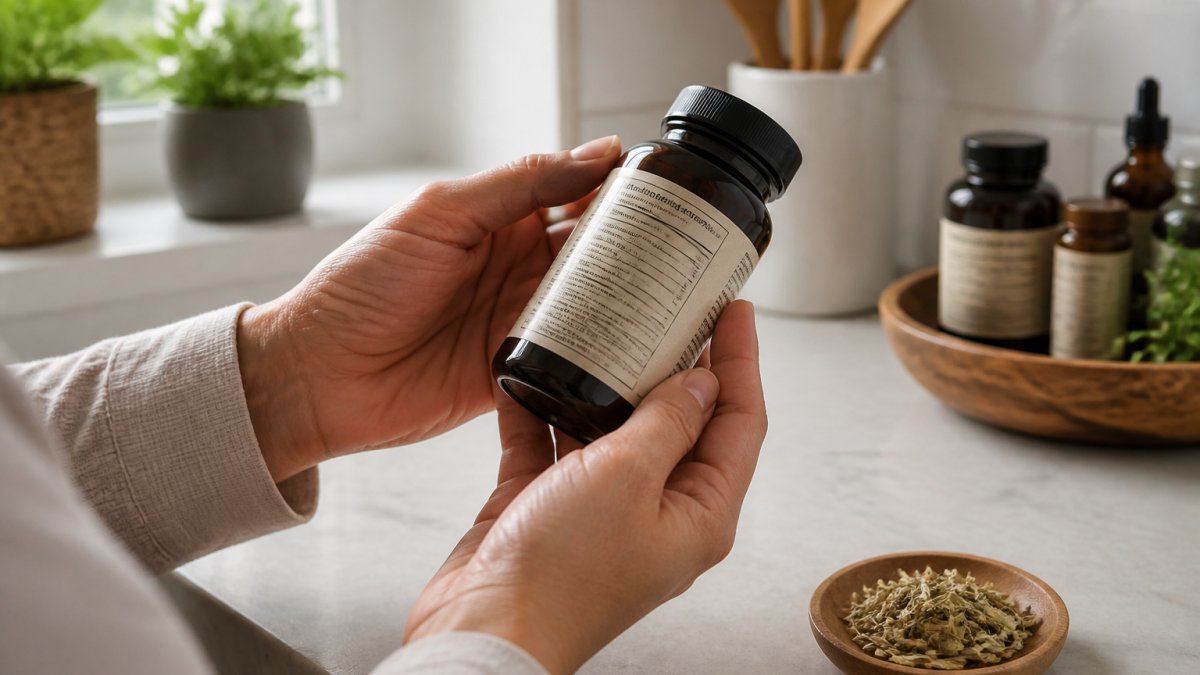
Quality is where most buying decisions go wrong. Two bottles can list identical herbs and deliver very different products, because the label rarely shows extraction method, plant part used, or how the ingredient was standardized.
Here is what to check before you buy, in the order that matters most.
1. Ingredient identity and plant part
Root, leaf, and extract are not interchangeable. Ashwagandha root and ashwagandha leaf are different products with different phytochemical profiles. A label that says only "ashwagandha" without the plant part is a yellow flag. Look for the Latin binomial (for example, Withania somnifera) and the part used (root, root extract, leaf).
2. Standardization and extract ratio
Standardization means the manufacturer has adjusted the extract to a stated marker compound, such as a percentage of withanolides or curcuminoids. A label reading "standardized to 5% withanolides" tells you more than "500 mg ashwagandha." Extract ratios (for example, 10:1) describe how much raw herb went into the extract but do not by themselves prove potency. Neither number replaces a stated marker compound.
3. Third-party testing and certificates of analysis
Independent testing is the closest thing to a quality guarantee a consumer can see. Common programs include NSF Certified for Sport, USP Verified, and ConsumerLab.com's reviewed-product seal. A certificate of analysis (CoA) is the manufacturer's batch-level record of identity, potency, and contaminant testing; a serious brand will share one on request. If a product claims third-party testing but names no program and offers no CoA, treat the claim as marketing.
4. Contamination and adulteration risk
Botanical ingredients carry known risks that testing is designed to catch: heavy metals from soil, pesticide residues, microbial contamination, and adulteration with cheaper plant material. Certain herbs are more frequently substituted than others, which is one reason single-ingredient products with clear sourcing are easier to evaluate than complex blends.
5. The Supplement Facts panel
Read the panel in this order:
- Serving size: A bottle with 60 capsules and a two-capsule serving is a 30-day supply, not 60.
- Amount per serving: Compare this to the labeled directions, not to the bottle size.
- Other ingredients: Fillers, flow agents, and proprietary blends can hide underdosed ingredients.
- Directions and warnings: A serious product states a usual dosage and warns about drug interactions.
6. Storage and expiration
Botanical extracts lose potency over time and are sensitive to heat and moisture. Check the expiration or best-by date, store away from the bathroom and stove, and discard products that smell off or have changed color.
A practical shortcut: if a label gives you the Latin name, the plant part, a standardized marker, a named third-party program or CoA, and clear directions, it has passed the first filter.
How to Choose Herbal Supplements That Fit Your Health Goals
Start with the goal, not the herb. Someone managing blood sugar support needs a different formula than someone seeking stress support or hormonal balance, and matching the product to the outcome is the single biggest factor in whether you notice anything.
Use this decision framework:
| Your Goal | Herbs Commonly Used | Typical Form |
|---|---|---|
| Stress and mood support | Ashwagandha, rhodiola, holy basil | Capsules |
| Digestive comfort | Ginger root, turmeric, enzymes | Capsules, tinctures |
| Immune support | Echinacea, elderberry | Capsules, syrups |
| Energy and vitality | Panax ginseng, rhodiola | Capsules |
| Heart and metabolic support | Garlic, berberine, turmeric | Capsules |
| Women's hormonal balance | Black cohosh, evening primrose | Capsules, oils |
| Men's wellness | Saw palmetto, ginseng | Capsules |
Single-herb supplements suit people who want to isolate one variable. Combination formulas save effort but make it harder to tell what's working. If you're new to herbs, start with one product at a time.
Herbal Supplements Safety and Side Effects: What to Watch For
Herbal supplements safety and side effects deserve more attention than most buyers give them. Botanicals are generally well tolerated, but "natural" does not mean risk-free, and the FDA regulates dietary supplements differently from drugs, which means the burden of judgment falls partly on you.
Common issues include digestive upset from ginger or turmeric in large amounts, and drowsiness with calming herbs like ashwagandha. Stop use and consult a clinician if you notice an allergic reaction, unusual fatigue, or stomach pain that persists.
Herbal Supplements and Medication Interactions
Herbal supplements and medication interactions are the most underrated risk in the category.
Ginkgo biloba and garlic are both associated with bleeding risk, which matters if you take anticoagulants. John's wort is well known for interfering with multiple drug classes (St. John’s Wort: Usefulness and Safety).
If you take prescription medication, bring your supplement list to your pharmacist before you start. This takes five minutes and is the highest-value step in the entire process.
Building a Daily Wellness Routine With Herbal Supplements
A routine beats a collection every time. The practical question most people ask is whether herbal supplements are appropriate for everyday use, and for many botanicals the answer is yes, provided you follow the label, track what happens, and take planned breaks where appropriate. What competitors rarely give you is a decision framework for daily use, so here is one.
Is daily use appropriate for you?
Daily use is a reasonable starting point when three conditions are met:
- You have a specific, modest goal such as stress support, digestive comfort, or general vitality, not treatment of a diagnosed condition.
- You have checked interactions with a pharmacist or clinician, especially if you take prescription medication or manage a chronic condition.
- You are willing to track results for four to six weeks before judging whether the product works.
Daily use is not appropriate as a substitute for prescribed treatment, during pregnancy or breastfeeding without clinician guidance, or for children without a pediatrician's input. Older adults should treat daily herbal use as a medication-review conversation, because the risk of interaction rises with the number of prescriptions in the regimen.
A simple daily structure
- Morning: Energy and vitality herbs, such as ginseng or rhodiola, taken with food.
- Midday: Digestive support, such as ginger or a digestive enzyme formula, before your largest meal.
- Evening: Stress and sleep support, such as ashwagandha or holy basil.
Take calming herbs in the evening and stimulating herbs in the morning. If a label gives no timing guidance, start with the time of day that matches the herb's traditional use.
Track effects, not just doses
Keep a short log with four columns: product, dose, time taken, and how you felt that day. Rate sleep, energy, digestion, and mood on a simple one-to-five scale. After four to six weeks, review the log honestly. If nothing has changed, stop the product rather than adding another bottle. If something has changed, note whether the change is worth the cost and the pill burden.
Plan breaks and know when to stop
Many practitioners recommend planned breaks, such as five days on and two days off, or a one-week pause every three months, to reassess whether the product is still needed. Stop use and consult a clinician if you notice an allergic reaction, unusual fatigue, stomach pain that persists, or any new symptom that appears after starting a product. Do not restart a product that caused a reaction without clinical advice.
Avoid duplicate ingredients when stacking
Combining supplements without checking labels is how people end up taking duplicate ingredients. Before you add a second product, compare Supplement Facts panels for overlapping herbs and cumulative doses.
At Andina Natural, our herbal formulations are organized by wellness category, including digestive, heart, and blood sugar support, so you can match a product to a goal rather than guessing. Orders over $50 ship free, and our site is secure from checkout to delivery.
Frequently Asked Questions
Are herbal supplements safe to take every day?
Many herbal supplements are taken daily, but safety depends on the herb, the dose, and your health history. Some botanicals, like ashwagandha and turmeric, have traditional daily use, while others are better suited to short-term use. Check the label for a stated daily dosage, start with one product at a time, and stop if you notice new symptoms. If you take prescription medication, have a chronic condition, or are pregnant, talk to a healthcare professional before making herbal supplements part of your daily wellness routine.
How do I choose a high-quality herbal supplement?
Look for the exact plant name and the part used (root, leaf, extract), a standardized extract percentage where relevant, and a clear amount per serving. Third-party testing marks and a stated manufacturer address are good signs. Avoid products with proprietary blends that hide individual doses, and be wary of claims that a single herb treats many unrelated conditions. For herbal supplement quality and ingredients, the label should tell you what is inside without vague filler terms.
Can herbal supplements interact with prescription medications?
Yes. Herbal supplements and medication interactions are common and sometimes serious. Ginkgo biloba and garlic can affect bleeding risk, St. John's wort changes how some drugs are metabolized, and berberine may interact with blood sugar and blood pressure medications. If you take prescriptions for heart health, diabetes, or blood thinners, share your full supplement list with your pharmacist or doctor before starting anything new.
Should I talk to a healthcare professional before taking herbal supplements?
It is a good idea, especially if you are over 40, manage a chronic condition, take multiple medications, or are pregnant or breastfeeding. A pharmacist can screen for herbal supplements and medication interactions in minutes. Bring the product label or a photo of it so the conversation is specific. For general wellness use in healthy adults, a quick check is still worthwhile before you commit to a daily routine.
Choosing herbal supplements well comes down to a plan, not a shelf full of bottles. If you're managing digestion, heart health, blood sugar, or everyday energy, Andina Natural carries herb-based formulations built around those specific goals, with free shipping on orders over $50 and a secure checkout. Browse the full range and start with one product matched to your health priority.