

Best Herbal Supplements for Skin Health: 2026 Guide
Table of Contents
- Why Herbal Supplements for Skin Health Are Worth a Closer Look
- Comparison Table: Best Herbal Supplements for Skin Health
- The Top Herbal Supplements for Glowing Skin, Ranked by Evidence
- How to Improve Skin Health Naturally Beyond the Bottle
- Do Skin Care Supplements Work? What the Evidence Says
- Herbal Supplement Safety and Interactions You Should Know
- How to Choose a Quality Herbal Supplement for Your Skin Concern
- Frequently Asked Questions
Last Updated: October 19, 2026
Why Herbal Supplements for Skin Health Are Worth a Closer Look
But most guides treat every herb the same, without saying which have real evidence, which need caution, or how to read a label.
Below, we sort the strong options from the weak ones, with a ranked comparison and buying checklist.
Herbal supplements for skin health are plant-based products taken by mouth to support skin function, hydration, and appearance, working from the inside unlike topical products.
Comparison Table: Best Herbal Supplements for Skin Health
| Ingredient | Main Benefit | Evidence Strength | Best For | Watch Out For |
|---|---|---|---|---|
| Collagen + vitamin C | Elasticity, firmness | Moderate | Signs of aging | Source quality varies |
| Turmeric | Antioxidant, calming | Moderate | Redness, oxidative stress | Blood thinner interactions |
| Green tea extract | Antioxidant protection | Moderate | Overall skin protection | High-dose liver caution |
| Gotu kola | Firmness, circulation | Limited | Skin firmness | Sedative effects |
| Ashwagandha | Stress support | Limited | Stress-related skin issues | Thyroid, pregnancy |
| Zinc | Skin renewal, healing | Good | Breakouts, healing | Nausea on empty stomach |
| Omega-3 fatty acids | Hydration, barrier | Good | Dry, sensitive skin | Fishy aftertaste |
How We Evaluated These Ingredients
We ranked each ingredient on strength of human research, safety for most adults, and ease of finding in a trustworthy form.
An ingredient with one small study ranks lower than one with several consistent trials, the honest way to compare herbal supplements for skin health.
The Top Herbal Supplements for Glowing Skin, Ranked by Evidence
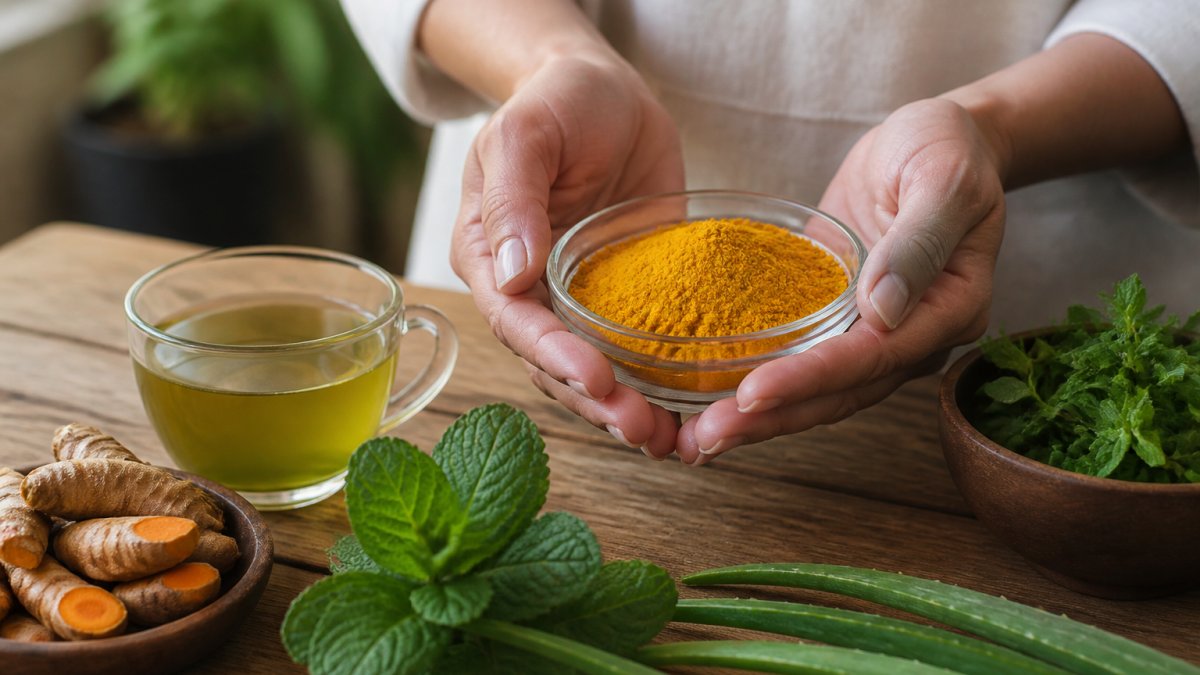
Ranking starts with the ingredients with the most consistent human research, grouped by what they do for your skin.
1. Collagen and Vitamin C: The Elasticity Duo
Collagen is the protein that keeps skin firm, and vitamin C helps your body produce it. Together they target elasticity and firmness, two common signs of aging.
Buying collagen alone is a common mistake: your body needs vitamin C to build new collagen, so pairing them makes more sense.
Look for hydrolyzed collagen, which is easier to absorb. Give it at least eight to twelve weeks before judging results.
2. Turmeric and Green Tea: Antioxidant Protection
Free radicals from sun, pollution, and stress drive oxidative stress, which speeds skin aging. Turmeric and green tea are two of the best-researched botanicals for antioxidant support.
Green tea's catechins help protect skin from oxidative damage, while turmeric's curcumin supports the body's antioxidant defenses.
One caution: high-dose green tea extract has been linked to liver issues in some people. Stick to moderate doses, and avoid concentrated extracts if you have liver concerns.
3. Gotu Kola and Ashwagandha: Firmness and Stress Support
Gotu kola is a traditional herb for skin firmness and circulation. Ashwagandha targets stress, which can show up as dullness and breakouts.
The evidence for both is thinner than for collagen or green tea, so treat them as supporting players, not the foundation of your routine.
4. The Supporting Cast: Zinc, Selenium, and Omega-3s
These minerals and fatty acids aren't herbs, but belong in any honest list of skin supplements. Zinc supports renewal and healing, selenium is an antioxidant, and omega-3s, including GLA oils, support hydration and the skin barrier.
Many people see more improvement from fixing a mineral gap than from adding another exotic botanical.
How to Improve Skin Health Naturally Beyond the Bottle
Supplements work best supporting good habits, not replacing them. How to improve skin health naturally:
- Drink enough water. Skin hydration starts with fluid intake.
- Protect your skin barrier. Use sunscreen daily and avoid harsh cleansers.
- Eat colorful plants. Fruits and vegetables supply vitamins, minerals, and antioxidants.
If you smoke or drink heavily, cutting back may do more for your skin than any pill.
Do Skin Care Supplements Work? What the Evidence Says
The honest answer: some do, some don't, and the difference is usually visible in the study design. Grade each ingredient by the human research behind it.
A four-tier evidence scale you can apply yourself
- Tier 1, Consistent human trials: Multiple randomized controlled trials (RCTs) in adults, ideally with a placebo arm, measuring skin outcomes such as elasticity, transepidermal water loss, or wrinkle depth. Collagen peptides, vitamin C, zinc, and omega-3 fatty acids sit closest to this tier.
- Tier 2, Mixed or small human trials: At least one RCT or several small studies, but with inconsistent doses, short durations, or different outcome measures. Turmeric/curcumin and green tea extract (oral) generally land here.
- Tier 3, Preliminary human data: Small pilot studies, open-label trials, or trials in a related condition rather than healthy skin. Gotu kola and ashwagandha are reasonable examples.
What the research actually measures
Skin supplement trials rarely measure "glow." They measure:
- Skin elasticity and firmness via cutometer or similar instruments.
- Transepidermal water loss (TEWL) as a proxy for barrier function and hydration.
- Skin surface hydration via corneometry.
When reading a product page or study abstract, ask which was measured and over how long. A four-week trial on self-reported "skin appearance" is weaker than a twelve-week trial with instrumented elasticity readings.
Ingredient-by-ingredient reality check
- Collagen peptides: The most consistent human evidence among oral skin ingredients, typically in trials of 2.5-10 g per day for 8-12 weeks, with outcomes including elasticity and hydration. Results are modest, not transformative.
- Vitamin C: Essential for collagen synthesis; deficiency clearly harms skin. Whether extra vitamin C above the Recommended Dietary Allowance improves skin in well-nourished adults is less established than the deficiency story.
- Zinc: Good evidence for supporting healing and for deficiency-related skin issues; weaker evidence for improving healthy skin in people with adequate zinc status.
The deficiency-first rule
People with a genuine dietary gap (low vitamin D, zinc, or omega-3 intake) often see more change from correcting it than from adding another botanical. If your diet is varied with no diagnosed deficiency, the ceiling on any supplement is lower than marketing suggests.
How to run a fair personal test
Pick one or two Tier 1 or Tier 2 ingredients, not five. Set a specific observable outcome (for example, "less tightness after cleansing") and give it at least eight to twelve weeks, matching most positive trials. Change nothing else major; if the outcome hasn't moved, stop the supplement rather than adding another.
Herbal Supplement Safety and Interactions You Should Know
Herbal supplement safety and interactions deserve more attention than most roundups give them. In the U.S., supplements are regulated as food, not drugs, so purity and labeling depend heavily on the manufacturer.
The interaction categories that matter most
- Anticoagulants and antiplatelets (for example, warfarin, apixaban, rivaroxaban, clopidogrel, aspirin): Turmeric/curcumin, ginkgo, garlic, and high-dose fish oil can add to bleeding risk through additive antiplatelet or anticoagulant effect. If you bruise easily or have had a bleeding event, raise this with your prescriber before adding any of them.
- Blood pressure and blood sugar medications: Some botanicals can lower blood pressure or blood glucose on their own, stacking with medication to cause dizziness or hypoglycemia. If you take medication for either, ask about monitoring rather than guessing.
- Thyroid medication (levothyroxine): Ashwagandha and some other adaptogens are not recommended without medical guidance in thyroid conditions, and timing relative to levothyroxine matters for absorption of the drug itself.
Dose thresholds and forms that change the risk picture
- Green tea extract: Concentrated extracts (often 300-1,000 mg of catechins per day in capsule form) carry the liver signal; brewed green tea does not. If you have any liver condition or drink alcohol heavily, skip the concentrated extract.
- Turmeric/curcumin: Standard culinary amounts are low-risk for most people. Concentrated extracts at gram-level doses are where bleeding-risk questions and digestive upset become more relevant.
- Vitamin A (retinol/retinyl palmitate): High-dose preformed vitamin A is teratogenic, meaning it can cause birth defects. Pregnancy guidance generally favors beta-carotene forms and avoiding high-dose retinol supplements unless a clinician directs otherwise.
- Zinc: Chronic high-dose zinc (well above the tolerable upper intake level for adults) can interfere with copper absorption and cause nausea, especially on an empty stomach.
Pregnancy, breastfeeding, and surgery
Pregnancy and breastfeeding are the clearest "ask first" windows. Beyond vitamin A, several botanicals lack adequate safety data in pregnancy, so avoid concentrated herbal extracts unless a clinician recommends them. For planned surgery, many anesthesiologists ask patients to stop bleeding-risk herbs (turmeric, ginkgo, garlic, high-dose fish oil) about two weeks beforehand; confirm the window with your surgical team.
Reading the regulatory picture correctly
The FDA's guidance on dietary supplements explains that supplements are not pre-approved for safety and efficacy the way drugs are, and that manufacturers are responsible for label accuracy. The NIH Office of Dietary Supplements fact sheets provide free, ingredient-level summaries including known interactions and upper intake levels. Use both before adding anything new, especially if you take prescription medication.
A practical safety checklist
- List every prescription, over-the-counter drug, and supplement you take, including dose.
- Check each new herb against that list for bleeding, blood pressure, blood sugar, thyroid, and liver interactions.
- Confirm pregnancy or breastfeeding status before starting any concentrated extract.
- Stop bleeding-risk herbs before planned surgery per your surgical team's instructions.
How to Choose a Quality Herbal Supplement for Your Skin Concern
Then check the label itself:
- Third-party testing: Look for a seal from USP, NSF, or ConsumerLab.
- Full ingredient amounts: Avoid "proprietary blends" that hide doses.
- Clear serving size: You should know exactly how much of each herb you get.
- Expiration date and lot number: Signs of a serious manufacturer.
At Andina Natural, we stock herb-based formulations across wellness categories, and every product page lists what's inside.
If you take medication for blood pressure, blood sugar, or a heart condition, run any new supplement past your doctor first.
Your skin changes slowly, and so do supplement results.
Andina Natural offers natural herbal formulations for skin, digestive, heart, and blood sugar support, with transparent ingredient lists and free shipping on orders over $50.
Frequently Asked Questions
How long does it take for herbal supplements for skin health to work?
Most herbal supplements for skin health need 8 to 12 weeks of consistent use before you notice visible changes. Skin renewal cycles run roughly 28 days, and collagen or elasticity improvements build more slowly. Antioxidant ingredients like green tea and turmeric may support skin barrier function sooner, but firmness and radiance changes take longer. Track your results with photos in the same lighting every two weeks rather than judging by feel alone.
Are herbal supplements safe to take with medications?
Not always. Herbal supplement safety and interactions depend on the specific herb and your prescriptions. Turmeric can interact with blood thinners, and ashwagandha may affect thyroid medication and blood sugar drugs. Green tea extracts in high doses have been linked to liver concerns. If you take medication for blood pressure, prediabetes, or thyroid function, talk to your doctor or pharmacist before adding any herbal supplement to your routine.
What should I look for when choosing an herbal supplement for skin?
Check for third-party testing seals such as USP or NSF, a full ingredient list with amounts per serving, and a manufacturing date. Look for standardized extracts that state the active compound percentage, like 95% curcuminoids in turmeric. Avoid products with proprietary blends that hide individual doses. Andina Natural lists its herb-based formulations clearly.
Do skin care supplements work better than topical products?
They work differently rather than better. Topicals act directly on the skin surface for hydration and barrier repair, while oral supplements support skin from the inside through collagen production, antioxidant protection, and inflammation balance. Many dermatologists suggest combining both. If you want to improve skin health naturally, oral antioxidants and collagen support can address elasticity and radiance that creams cannot reach, but results depend on consistent use and realistic expectations.